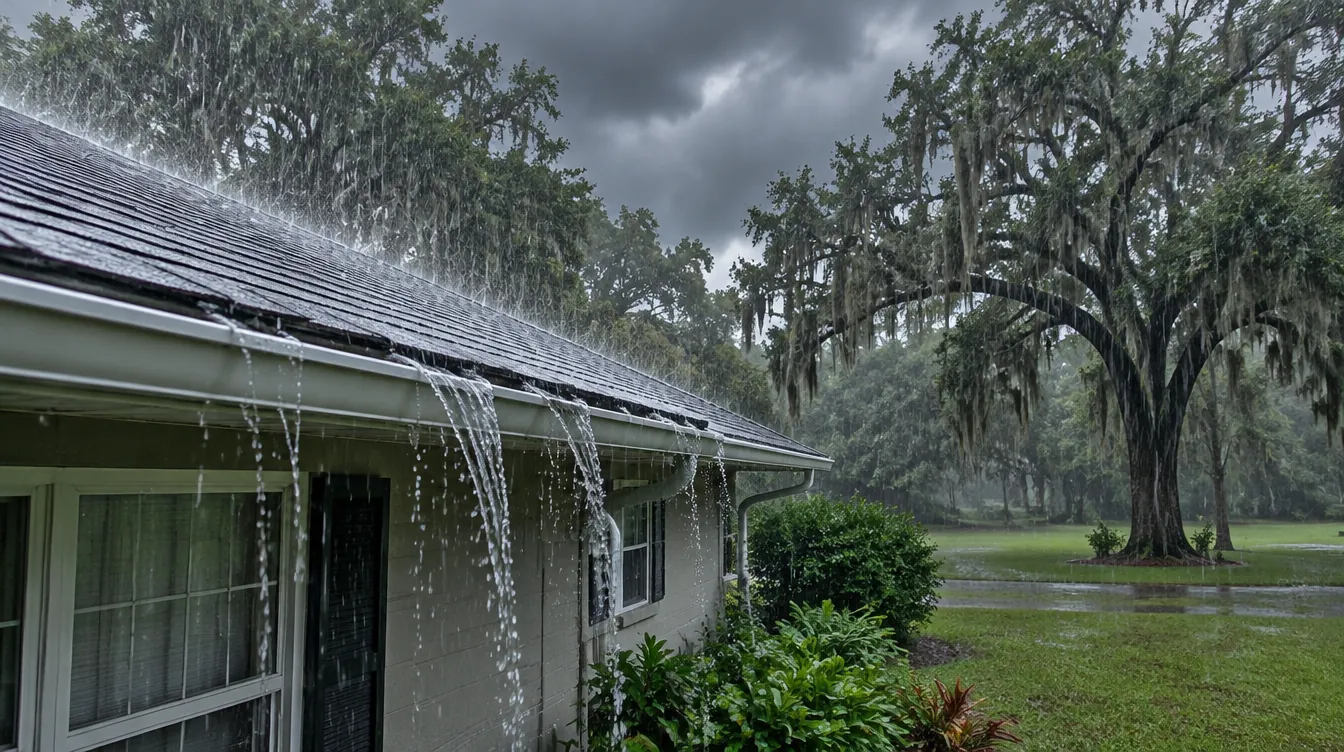
Most Gainesville roofs came through Hurricane Isaias without damage. The storm made landfall near Destin on October 9, 2026, far west of Alachua County, so we got heavy rain instead of hurricane-force wind. If your roof did take damage, Florida law gives you one year from the date of loss to report it. Here is what to check, and what to do if you find something.
What did Hurricane Isaias actually do in Gainesville?
Isaias was the first hurricane of the 2026 Atlantic season. It reached Category 3 strength and came ashore on the Florida Panhandle near Destin on the night of Friday, October 9.
Gainesville sat well outside the landfall zone. The National Weather Service in Jacksonville issued a flood watch for Alachua County, covering Gainesville, Alachua, High Springs, Newberry and Archer. Forecasters expected 1 to 3 inches of rain across the weekend.
That matters for how you check your roof. After a wind event, you look for missing shingles. After a heavy rain event like this one, the risk is water finding a weak spot that already existed.
What should I check after heavy rain?
Start inside, where it is safe, then look at the outside from the ground. Do not climb onto a wet roof.
Inside the house:
- Brown rings or stains on ceilings, especially in top-floor rooms and closets
- Bubbling paint or soft drywall near the ceiling line
- A musty smell in rooms that did not have one before
In the attic, with a flashlight:
- Damp or matted insulation
- Dark spots or water lines on the underside of the roof decking
- Wet framing around plumbing vents, chimneys and skylights
Outside, from the ground:
- Missing, lifted or creased shingles
- Shingle granules collecting at the bottom of downspouts
- Gutters that overflowed and pushed water back under the roof edge
- Flashing pulled away from chimneys, vents or walls
- Leaves and debris piled in roof valleys, where two slopes meet
Gainesville's tree canopy makes that last one common. Debris in a valley acts like a dam, and heavy rain backs up behind it.
Is it storm damage or just an old roof?
This distinction decides whether insurance is involved. Homeowners policies generally cover sudden damage from a covered event, not gradual wear. A roof that leaks in a 3-inch rain may have had a problem long before Isaias.
| Points toward storm damage | Points toward age and wear |
|---|---|
| A leak that started during the storm | A stain that has grown slowly for months |
| Shingles torn or missing after the storm | Brittle, curling shingles across the whole roof |
| A limb or debris impact | Bald patches where granules wore off over years |
| Damage concentrated in one area | Cracked sealant around vents and pipes |
Either way, a leak needs attention. Water in an attic turns into rotted decking and mold faster than most people expect in Florida humidity.
How long do I have to file an insurance claim in Florida?
One year from the date of loss, for a new or reopened claim. Florida cut that window in half under Senate Bill 2-A, signed in December 2022.
| Deadline | Before SB 2-A | Now |
|---|---|---|
| Report a new or reopened claim | 2 years | 1 year |
| File a supplemental claim | 3 years | 18 months |
| Insurer inspects your property | 45 days | 30 days |
| Insurer pays or denies the claim | 90 days | 60 days |
For Isaias damage, the clock started the day the damage happened. Do not wait for the deadline. Evidence is easiest to gather now, while the cause is fresh.
Document it today:
- Photograph every stain, wet spot and damaged shingle, with the date visible.
- Keep receipts for anything you spend to stop more water getting in, such as a tarp.
- Write down when you first noticed the problem.
- Call your insurance agent before signing anything with a contractor.
This is general information, not legal advice. Your agent can tell you exactly what your policy covers.
What should I watch out for after a storm?
Storms bring out contractors who are not from here and will not be here next year. A few rules protect you.
Never sign over your insurance benefits. Florida now prohibits assignment of benefits on property policies issued on or after January 1, 2023. A contractor asking you to hand over control of your claim is a red flag.
Check the license. Every roofing contractor in Florida must hold a state license. Look it up at MyFloridaLicense.com before anyone touches your roof. Godwin's is CCC#1329478.
Be wary of large upfront deposits. Godwin requires no deposit at all, and payment is due 10 days after the job is complete.
Get it in writing. A real estimate lists the materials, the scope and the permit.
Frequently asked questions
Get a straight answer about your roof
If you found something on that checklist, Chris will tell you what he actually sees, including whether it is storm damage, normal wear, or nothing to worry about. Every Godwin job is done by our in-house crew, never subcontractors, with permits pulled and two inspections.
No deposit is required, and financing is available from $3,000 to $75,000.
Get a Free Roofing Inspection in Gainesville
Christopher Tenney personally handles every estimate. License CCC#1329478. No deposit required.
Written by Christopher Tenney, owner of Godwin Green Roofing. Chris is a Florida Certified Roofing Contractor (CCC#1329478), a 2008 University of Florida graduate, and president of the North Central Florida Roofing Association. Godwin Green Roofing has served Gainesville and North Central Florida since 1974.